Salesforce Omni-Channel: Prioritize Work Items by Due Date for 🎯 Better SLA Compliance
Introduction: Why Due Date Routing is a Game-Changer for Service Teams
In today’s fast-paced service environment, meeting your Service Level Agreements (SLAs) isn’t just a goal—it’s a customer expectation. Historically, Salesforce Omni-Channel routing relied heavily on Primary and Secondary Priority to push urgent work to agents. While effective, this approach often struggled to respect the actual clock on a service request.
Enter the Acceptance Due Date in Salesforce Omni-Channel Flow.
This powerful, yet often overlooked, feature is the key to transforming your routing strategy from simply “high-priority first” to “SLA-critical first.” By incorporating the work item’s due date into the routing logic, you can ensure that the cases, leads, or other work items closest to violating an SLA are routed to an agent with precision and urgency.
Understanding the Core Concept: The Acceptance Due Date
The Acceptance Due Date is a field available within the Route Work Flow element in an Omni-Channel Flow. It allows the Omni-Channel routing engine to use a date/time value to further refine the prioritization of work items waiting in a queue.
How does it work?
- You define and calculate an Acceptance Due Date (a date/time value) for your work item (e.g., a Case) in your Omni-Channel Flow. This date is the time by which an agent must accept the work item to meet the SLA.
- You pass this date/time value into the Acceptance Due Date field of the Route Work Flow action.
- The Omni-Channel engine automatically prioritizes the queue. Work Items that are closest to, or already after, this date are prioritized higher within the same Primary and Secondary Priority levels.
This effectively turns the time remaining into the ultimate tie-breaker for your most critical service requests.
The Problem Solved: Respecting Service Level Agreements (SLAs)
Imagine two work items in a queue with the same Primary Priority (e.g., Priority 2):
| Work Item | Primary Priority | Acceptance Due Date |
| Case A | 2 | 2 hours from now |
| Case B | 2 | 8 hours from now |
Without the Acceptance Due Date, the system would route them based on the oldest item in the queue.
With the Acceptance Due Date, Case A will be routed first. Why? Because its due date is much closer, meaning it’s at a higher risk of violating the SLA. This capability is vital for organizations managing different service tiers or support contracts with varying resolution times.
Implementation in Salesforce Flow: Your 3-Step Guide
Integrating Due Date routing is done entirely within your Omni-Channel Flow:
Step 1: Calculate the Due Date Variable
Before the Route Work action, you need to determine the date/time the work item should be accepted.
- Use a Formula or Assignment element in your Flow to calculate this value based on your business logic.
- Pro-Tip: If you are using Salesforce Entitlements and Milestones on Cases, you can dynamically query the
CaseMilestonerecord to retrieve the Target Date of the relevant Milestone and use that value directly!
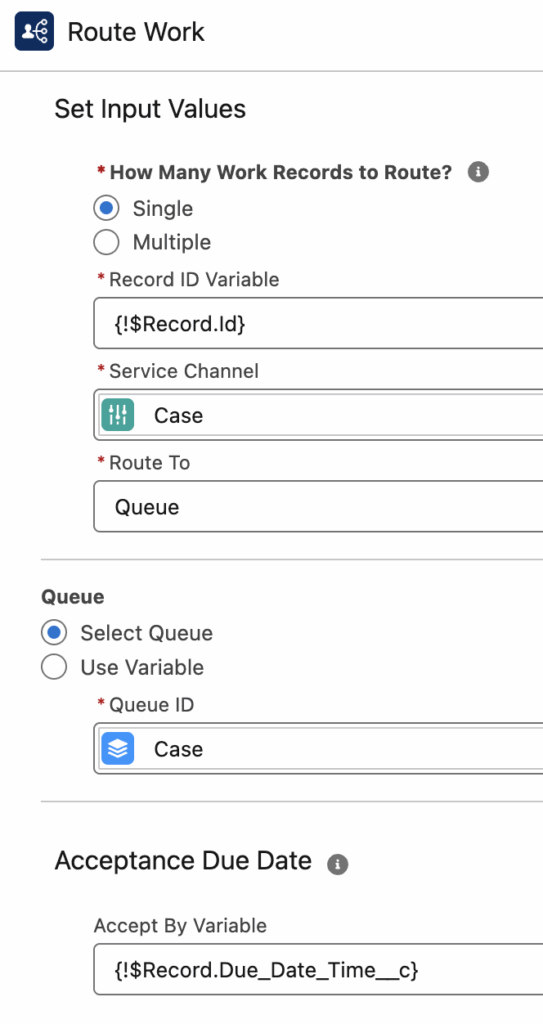
Step 2: Use the Route Work Action
In the Route Work element, you’ll find the specific field:
- Field to Use:
Acceptance Due Date - Input: Pass the date/time variable you calculated in Step 1.
Step 3: Unify Priority for True Urgency
To ensure the Acceptance Due Date is the main driver for SLA adherence, consider unifying your Primary Priority across all work items that share a common service goal (e.g., set all standard SLA cases to Primary Priority = 3).
The routing engine’s priority order is as follows:
- Primary Priority (Lowest number wins)
- Secondary Priority (Lowest number wins)
- Acceptance Due Date (Earliest date/time wins)
- Date Entered Queue (Oldest work wins)
By making items 1 and 2 the same, you allow item 3 (Acceptance Due Date) to truly prioritize work by time remaining.
Conclusion: Elevate Your Service with Time-Based Routing
The Acceptance Due Date feature in Salesforce Omni-Channel is more than just a configuration setting; it’s a strategic tool for operational excellence. By leveraging this date/time field in your routing logic, you move beyond basic priority rules and gain the precision needed to respect every customer’s deadline, resolve high-priority items faster, and consistently meet your Service Level Agreements. Start implementing time-based routing today and watch your service team’s efficiency soar!