If you build or administer Agentforce solutions, you will eventually ask how Salesforce Agentforce Coworker decides when to hand a request to another agent. This post explains how Agentforce Coworker invokes an Agentforce Employee Agent, what it reads to make that decision, and what to design around.
What Is Salesforce Agentforce Coworker Delegation?
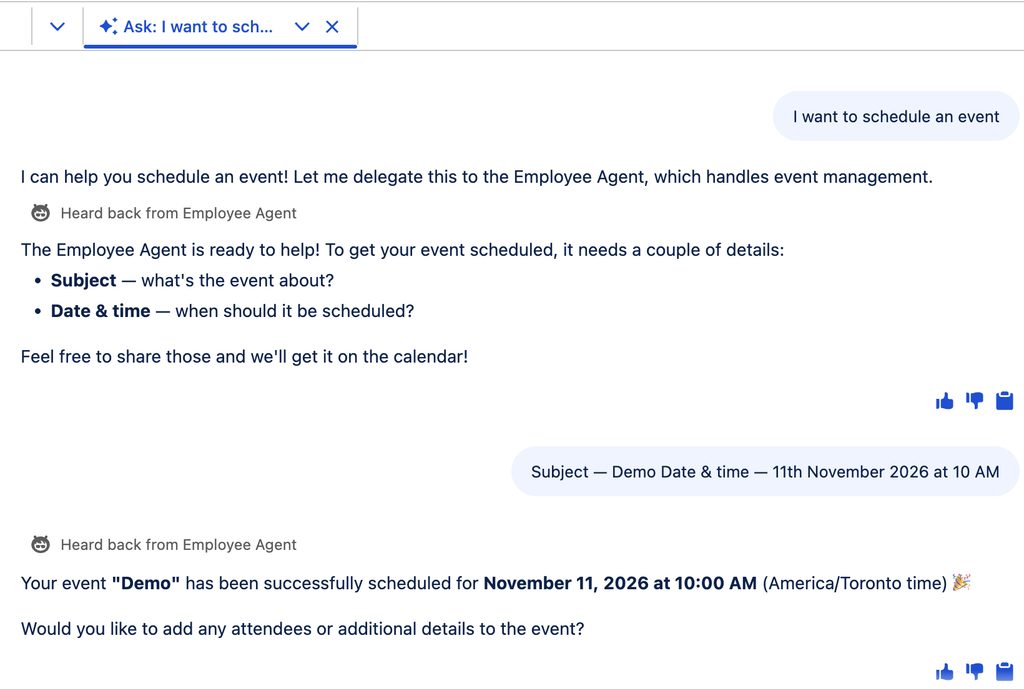
Agentforce Coworker doesn’t have to complete every request itself. When a user makes a request that Agentforce Coworker can’t complete, it looks for another Agentforce agent that can. This delegation lets one entry point serve users while specialized agents, such as an Agentforce Employee Agent, handle the work they’re built for.
How Agentforce Coworker Routes a Request
When Agentforce Coworker can’t complete a request, it follows this sequence:
- A user submits a request to Agentforce Coworker.
- Agentforce Coworker can’t complete it on its own.
- It reads the descriptions of the agents and subagents for the Agentforce agents that user can access.
- It compares the request with each agent’s capabilities.
- It delegates the request when it finds a match.
The user’s access matters here. Agentforce Coworker considers only the Agentforce agents that the requesting user can access, so two users can get different routing outcomes for the same request.
What Agentforce Coworker Reads, and What It Ignores
Note: Agentforce Coworker uses only agent and subagent descriptions to route the request. It doesn’t use subagent instructions.
This is the most important detail for builders. Your routing quality depends on the descriptions you write, not on the instructions inside a subagent. Detailed, well-crafted instructions won’t influence whether Agentforce Coworker chooses your agent.
Best Practices for Reliable Delegation
The source note states the routing behavior, not these practices. They are my inferences from it, so test them in a sandbox before presenting them as guidance:
- Write descriptions around capabilities. Routing compares the request with each agent’s capabilities, so state what the agent can do in the words your users would use.
- Keep descriptions distinct across agents. Overlapping descriptions make a match ambiguous.
- Describe your subagents too. Both agent and subagent descriptions are read.
- Don’t rely on instructions to steer routing. Put routing-relevant information in the description, because instructions aren’t used for this decision.
- Verify access. If delegation doesn’t happen, confirm the user can access the target agent.
- Test with realistic requests. Try varied phrasings against your descriptions. [TBD: add the test method or tooling you used.]
Frequently Asked Questions
Does Agentforce Coworker use subagent instructions to choose an agent?
No. It uses only agent and subagent descriptions to route the request.
Which agents can Agentforce Coworker delegate to?
Agentforce agents that the requesting user can access.
When does Agentforce Coworker delegate?
When it can’t complete a request itself and finds a match between the request and an agent’s capabilities.
Conclusion
Agentforce Coworker delegation depends on clear agent and subagent descriptions and on user access. Review your descriptions first when routing doesn’t behave as expected.